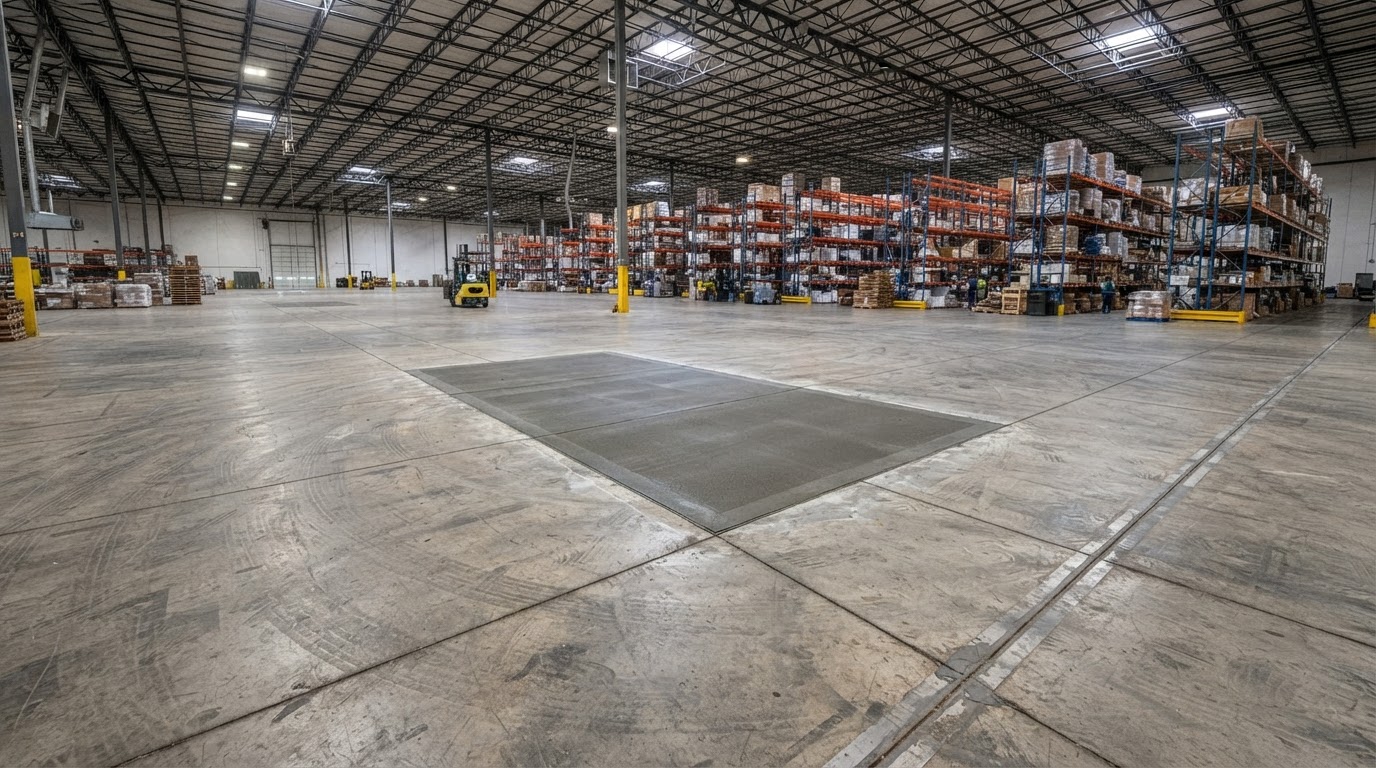
Industrial concrete repair
Our work focuses on repairing floors and joints to support safer, smoother facility operations.
- Damaged slab replacement
- Floor joint repairs
- Localized concrete repairs
- Concrete surface restoration

Concrete repair solutions for industrial facilities, warehouses, distribution centers, and commercial workspaces.
Damaged concrete floors and joints can interfere with forklifts, material-handling equipment, and daily operations. We provide concrete repair solutions for industrial facilities, warehouses, distribution centers, and commercial workspaces.
Floor joints take heavy wheel loads, and damaged joint edges transmit impact to equipment and the slab. Cracks and spalling can slow movement and create safety concerns in an operating facility.
Repairs are planned around how the facility operates. Where possible, work is phased so areas remain accessible and the facility keeps moving during the project.
Read about concrete saw cutting & joint sealingIndustrial concrete repair ranges from localized slab and joint repair to floor surface restoration.
Our work focuses on repairing floors and joints to support safer, smoother facility operations.
Repairs in an operating facility are planned around access, safety, curing times, and the materials used.
Timely repairs can help reduce equipment impacts, improve floor conditions, and support safer facility operations. Smooth joint edges and sound slabs reduce the shock loads that forklifts and equipment transmit through the floor.
Joint repair and resealing are a common part of industrial floor maintenance. The concrete saw cutting and joint sealing page describes how joints are maintained to protect the slab.
Where slabs are damaged beyond joint repair, the concrete repair and replacement page covers slab removal and replacement.
See concrete repair & replacementFacility operations, floor condition, and loading guide the repair plan.
Feedback about working with Blackstone Roadway Consultants.
Customer reviews will appear here when our review feed is connected.
Many repairs can be planned in phases, depending on site access, safety requirements, repair materials, and curing times.
Heavy wheel loads, joint edge spalling, and load transfer issues contribute to joint damage. Repairing edges and restoring load transfer helps reduce further damage.
Work areas are sequenced so that portions of the floor remain in use while others are repaired and cured. The phasing depends on the facility layout, traffic, and the materials used.
Share your property location, the work you need and the result you have in mind. Photos, plans and information about the existing conditions can help explain your project.